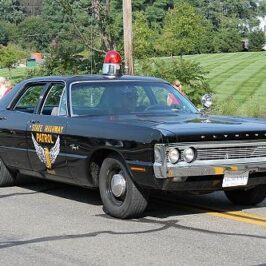
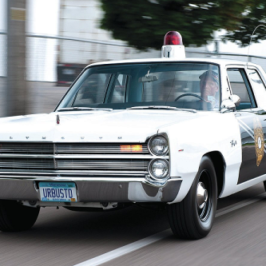
I’ve been disappointed by the lack of enthusiasm surrounding America’s 250th birthday, so I thought it would be fun to look back at one of the best examples of how law enforcement agencies celebrated the nation’s Bicentennial in 1976.
In 1976, the Illinois State Police commemorated the Bicentennial by giving each of its police districts a 1976 Plymouth Fury wearing a unique patriotic paint scheme. While the cars retained the standard Illinois State Police markings, they received a special red, white, and blue livery that made them instantly recognizable.
The standard Illinois State Police livery consisted of upper and lower gold stripes outlined with a dark brown accent that ran the length of the car. The Bicentennial cars replaced those gold stripes with a red upper stripe and a blue lower stripe, each outlined with matching accent borders, while retaining the standard Illinois State Police door emblem.
The patriotic theme continued across the rest of the car. The hood featured red and blue chevron stripes that met at the front edge, while matching stripes on the trunk converged at the rear. A break in the rear quarter-panel stripe made room for a blue “1776” decal, and both C-pillars carried an “E Pluribus Unum” emblem surrounded by thirteen blue stars representing the original colonies. Instead of the standard gold stripe and dark brown “State Police” decal across the rear of the trunk, the Bicentennial cars simply displayed STATE POLICE in large blue lettering.
Other than the special graphics package, the Bicentennial cars were equipped just like every other Illinois State Police cruiser of the era. They featured an all-red Federal Signal Twinsonic lightbar, a Federal Signal electronic siren, and two Motorola radios.

Radio 1: Main Low-Band Radio
The primary radio operated on VHF Low Band (around 42 MHz) and handled the Illinois State Police’s day-to-day communications. Low-band frequencies were ideal for statewide patrol because their long wavelengths could cover great distances across Illinois’ relatively flat terrain, allowing troopers to remain in contact with their district headquarters from many miles away.
Radio 2: ISPERN (Illinois State Police Emergency Radio Network)
The second radio operated on the VHF High Band (around 155 MHz) and was dedicated to interoperability. It allowed Illinois State Police troopers to communicate directly with municipal police departments and county sheriff’s offices that did not operate on the state’s low-band system. To eliminate confusion inside the patrol car, the ISPERN radio used a bright red microphone. Whenever a trooper grabbed the red microphone, they knew they were transmitting on the statewide emergency interoperability channel that neighboring agencies monitored.
Interesting Note: The Ohio State Highway Patrol used a similar interoperability network called LEERN (Law Enforcement Emergency Radio Network).
The large black object hanging from the rear passenger window in several of the photos is the antenna for the patrol car’s traffic radar unit.
I think this is one of the most patriotic police car liveries ever placed into service. The only thing that surprises me is that it doesn’t actually include an American flag anywhere in the design.
A special thanks goes to the individual who restored this remarkable Illinois State Police Plymouth Fury and continues to preserve an important piece of law enforcement history.

Photo Gallery


About The Author

Code 3 Garage
I started my career as a police officer in 1989 with the Geneva on The Lake Police Department. I worked part time as a police officer and full time as a Security Sergeant doing armed mobile security patrols for a local security company. In 1990 I became a State Trooper with the Ohio State Highway Patrol. During my career as a State Trooper I was certified as a Technical Crash Investigator, OPOTA Police Instructor, OPOTA Police Driving Instructor, LASER Instructor, and received awards for ACE (Auto Larceny) and Post Trooper of The Year. Code 3 Garage is a mix of my inner automotive gearhead, and public safety background. I hope you enjoy it!