

Introduction
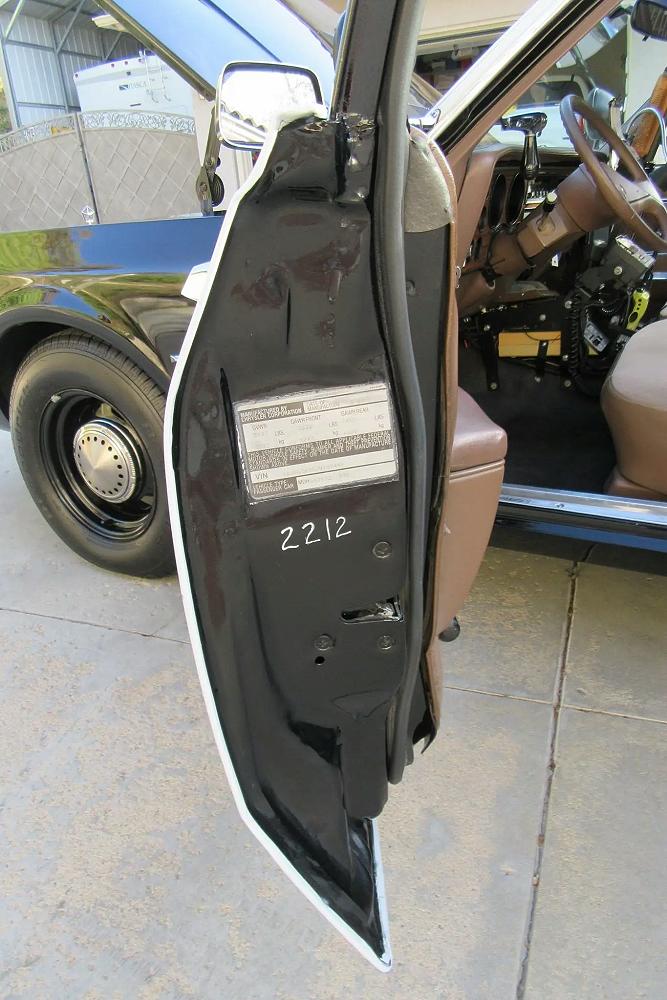
If you’ve ever looked closely at a restored California Highway Patrol (CHP) car, you may have noticed a 4-digit number hand painted on the front and rear of the vehicle as well as on the inside of the driver’s door. These hand painted numbers represent the vehicle’s specific CHP Shop Number or asset tracking ID. When cars were delivered to the CHP Central Garage in Sacramento, they were stripped of standard dealership branding and assigned an internal inventory number. This hand-painted number tracked maintenance intervals, deployment locations, and eventual decommissioning.
Why Were They Hand Painted
Unlike modern law enforcement agencies that use pre-cut adhesive vinyl decals, the CHP traditionally used standard hand-painted numbers for vehicle identification during the 1960s and 1970s.
Durability: Early vinyl adhesives easily cracked, peeled, and bubbled under intense California desert heat. Industrial-grade paint bonded directly to Mopar’s factory finish, ensuring the numbers survived constant high-speed wind resistance and intense UV exposure.
The Sacramento Custom Decom Workflow: When a patrol car hit its maximum service mileage and was prepared for public auction, the Central Garage used a chemical solvent or sander to quickly strip the hand-painted numbers and agency stars off the body panels, rendering the car legal for civilian title transfer.
Does The Number Break Down?
Let’s use the car above as an example.
The number 7091 is purely sequential.
Under the CHP system, the first two digits “70” denoted the fiscal order year (contract year 1970–1971), and “91” meant it was the 91st vehicle processed in that production block.
A Polara with shop number 7091 could have spent its entire service life in San Diego, while car 7092 was sent straight to the Oregon border. The numbers stayed with the car from birth to the auction block, regardless of where it was stationed.
Why Were They So Small?
The tiny size of the numbers on the outer body panels comes down to a strict division between a vehicle’s legal identity and its internal asset tracking:
Public Accountability vs. Internal Inventory: Unlike modern police fleets that display massive unit numbers on the roof or trunk for citizen identification, the CHP’s external graphics strategy was historically conservative. Under California vehicle protocol, the public was expected to report complaints or identify specific cruisers using the state-issued exempt license plate or by naming the localized CHP Geographic Area painted on the side of the car (e.g., “El Centro” or “Barstow”). The agency saw no operational need to clutter the classic black-and-white aesthetic with massive public-facing unit decals.
The Corner Markings Were Hand-Brushed Inventory Tools: The tiny, 1-to-2-inch tracking numbers found on the tips of the front and rear fenders were never meant to be read from a distance or by the public. They were freehand numbered using a fine brush and white enamel paint, which is why original survivors always exhibit distinct brush strokes rather than the hard, uniform edges of a stencil or decal.
These hand-brushed numbers functioned strictly as inventory control stamps. When hundreds of identical black-and-whites were delivered bare to the Motor Transport Division in Sacramento, they lacked license plates or any defining external markings. Fleet workers used these small, standardized corner numbers as a quick, uniform way to verify a vehicle’s serial identity while it was parked on the staging lot being outfitted with high-draw electrical equipment.
Why Were They Inside the Door
Finding the matching shop number hand-painted or grease-penciled on the unfinished interior door jambs, under-hood radiator supports, or trunk gutters is a direct artifact of the assembly and decommissioning workflow:
The Custom Fabrication Process: At the Sacramento central garage, teams of technicians frequently had to pull doors, interior panels, and heavy interior brackets apart to route the specialized, thick-gauge dual-siren harnesses and heavy radio cables. Painting the unique shop number on the raw inner sheet metal ensured that panels removed from car 7091 during fabrication didn’t accidentally get reinstalled on car 7092 further down the line.
The “De-Policing” Loophole: When a vehicle reached its 70,000–80,000 mile deployment limit, it was returned to Sacramento to be stripped for public auction. California law strictly required the removal of all outward law enforcement markings to prevent civilian misrepresentation. While the Central Garage could quickly use a chemical solvent, sander, or a fast blast of black spray paint to erase the small exterior corner number, technicians rarely wasted labor opening the doors or popping the hoods to scrub down the hidden internal markings. This administrative shortcut inadvertently left behind a permanent historical blueprint for modern collectors to verify a genuine, matching-numbers CHP body chassis.
CHP Shop Number to State-Issued License Plate Numbers
The practice of matching the CHP shop number to the vehicle’s state-issued license plate numbers officially began in 1982.
Prior to this shift, the shop number and the license plate had absolutely nothing to do with each other. Your 1971 Dodge Polara carried a shop number (7091) stamped at the factory level, but the California Department of Motor Vehicles (DMV) simply issued standard, sequential “E” (Exempt) diamond-stamped plates from whatever box they happened to crack open at the garage that week.
The main reason for this change was to make things much easier on dispatchers, field officers, and mechanics. Before 1982, if an officer was calling out on the radio or a supervisor was doing paperwork, they had to keep track of two entirely different asset numbers for the exact same piece of sheet metal: the DMV license plate number and the internal CHP shop number.
Pre 1982 License Plates:


The Long-Running “E” Prefix Era (Pre-1999): When the CHP implemented the unified shop-number system in 1982, the plates being issued were from this classic “E” series that utilized a diamond-stamped “E” prefix followed by a string of numbers. If a 1985 Mustang SSP had the shop number 8302, its physical license plate read E008302 or E8302 (with the trailing digits matching the car).
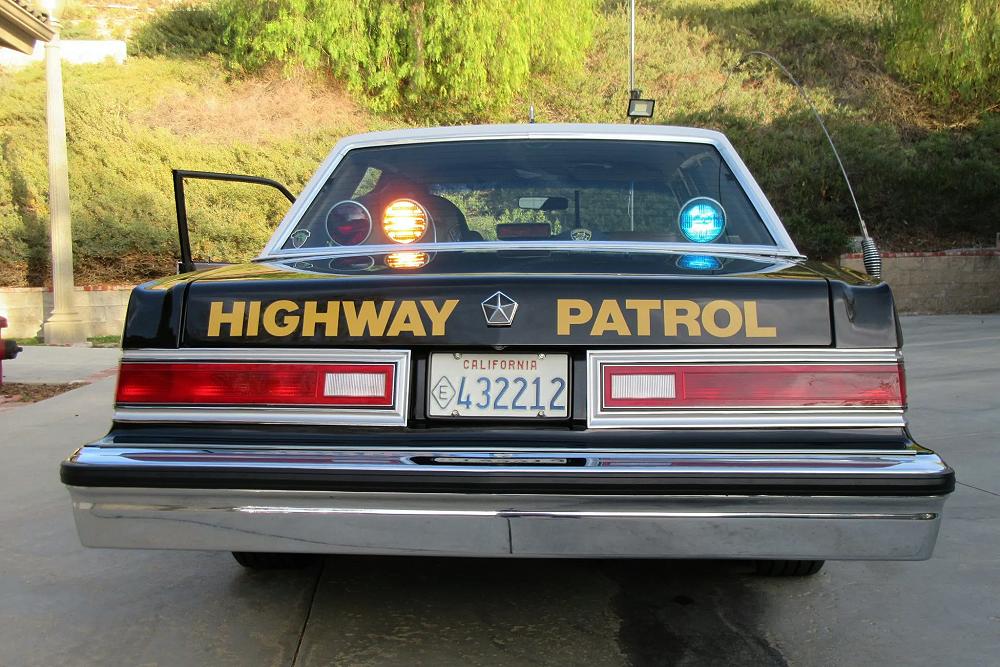
The Move to the “1” Prefix (1999): The DMV did not introduce a leading “1” to the Exempt series until approximately 1999. At that point, the state was running out of numeric combinations under the old “E” formatting. To expand the system, the DMV eliminated the “E” prefix entirely and rolled out a new 7-digit configuration that started with the number 1, followed by six digits and the screened text “CA EXEMPT” along the top (e.g., 1022415).


The End of Small Hand-Painted Markings
Once the license plate itself proudly displayed the shop number, the traditional practice of having a mechanic meticulously hand-paint the tiny asset numbers on the edge of the front and rear fenders quickly died out. The large, highly visible stamped aluminum state license plate became the single source of truth for tracking the vehicle in the maintenance lanes and the database logs.
About The Author

Code 3 Garage
I started my career as a police officer in 1989 with the Geneva on The Lake Police Department. I worked part time as a police officer and full time as a Security Sergeant doing armed mobile security patrols for a local security company. In 1990 I became a State Trooper with the Ohio State Highway Patrol. During my career as a State Trooper I was certified as a Technical Crash Investigator, OPOTA Police Instructor, OPOTA Police Driving Instructor, LASER Instructor, and received awards for ACE (Auto Larceny) and Post Trooper of The Year. Code 3 Garage is a mix of my inner automotive gearhead, and public safety background. I hope you enjoy it!