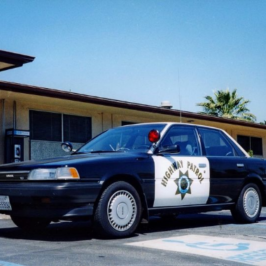
1982 California Highway Patrol Mustang Prototype – Unit 1963
The 1982 Ford Mustang California Highway Patrol (CHP) Prototype, Unit 1963, holds a special place in the history of American law enforcement vehicles. Before the Ford Mustang Special Service Package (SSP) became a familiar sight in police fleets across the country, this Mustang was helping Ford and the California Highway Patrol develop what would become one of the most recognizable police cars of the 1980s and early 1990s.
I first mentioned this Mustang in my article, 1982 – The Start of The Police Mustangs, which covered the early development of Ford’s police Mustang program and the two 1982 vehicles associated with Ford fleet manager Emil Loeffler. This particular car deserves a closer look of its own, especially considering its unusual history after the initial testing was completed.
Developing the CHP Mustang
In the early 1980s, the California Highway Patrol was looking for a vehicle that could meet its high-speed pursuit requirements. The agency had evaluated a 1979 Chevrolet Camaro Z28 but was not satisfied with its performance.
Ford fleet manager Emil Loeffler and his team worked to develop a Mustang that could meet CHP’s requirements. The first prototype was built in December 1981 and delivered to the California Highway Patrol for testing and evaluation.
The Mustang was evaluated at the CHP Training Academy in Sacramento during January and February 1982. Performance requirements included acceleration to 100 mph within a specified time, stopping within a prescribed distance, and achieving a top speed exceeding 125 mph.
The Mustang met those requirements, and CHP proceeded with an order for approximately 400 of the 1982 Mustangs equipped with Ford’s Severe Service Package. Some historical accounts cite the order as 406 vehicles.
Although Ford would use the name Special Service Package (SSP) when marketing the Mustang to other law enforcement agencies beginning in 1983, the program’s origins were firmly established in 1982.

From Prototype to EVOC Training Car
After its initial research and development work, the prototype was given another assignment.
The California Highway Patrol needed a vehicle for its Emergency Vehicle Operators Course (EVOC) at the CHP Academy in Sacramento. The program trains officers in the safe operation and handling of emergency vehicles, including high-speed driving techniques.
Rather than take one of the newly ordered production Mustangs and dedicate it to driver training, CHP decided to use the original 1982 prototype.
Ford reportedly sold the car to the California Highway Patrol for just $1.00. Ford also paid to have a full roll cage installed, with the work performed by Bill Stroppe. Stroppe was well known for his involvement in off-road racing and vehicle preparation, as well as his work with Indy cars.
The roll cage transformed the Mustang from a development vehicle into a purpose-built training car. It would go on to serve as one of the vehicles used to train CHP officers in emergency vehicle operation.
The Mustang remained in EVOC service until late 1985, when it was retired and subsequently sold.

Identifying the Prototype
One of the interesting details that distinguishes Unit 1963 from the production CHP Mustangs is the location of its radio antenna.
Because the Mustang was originally built for research and development, its antenna was mounted on the passenger side. Production CHP patrol Mustangs generally had their antennas mounted on the driver’s side.
The car also retained its original black paint and black interior, with the familiar black-and-white California Highway Patrol markings applied for its service.
The car is powered by Ford’s 5.0L High Output V8 paired with a four-speed SROD manual transmission. Its original configuration included power steering, power disc brakes, factory air conditioning, TRX suspension, power door locks, and cruise control.
The car’s VIN is 1FABP10F4CF148027.

A Survivor From the Beginning of the SSP Program
The prototype survived its years of CHP service and eventually made its way into private ownership.
In 2014, the Mustang was reportedly advertised for sale on eBay in Tennessee. Its survival is significant because it represents an early chapter in the development of Ford’s police Mustang program.
The car later appeared at Mecum’s Kissimmee auction in January 2024 as Lot J218.1.
The auction listing identified it as the 1982 Ford Mustang SSP EVOC CHP Prototype and highlighted its history as the first EVOC car and California Highway Patrol Prototype Unit 1963.
The odometer displayed 94,059 miles. The auction documentation included a Certificate of Affidavit, Deluxe Marti Report, Eminger Report, vintage photographs, and a magazine article documenting the vehicle’s history.
The Mustang received a high bid of $55,000 but was reported as not sold.
An Important Piece of Police Mustang History
The Ford Mustang SSP eventually became a familiar sight in law enforcement fleets throughout the United States. State police agencies, highway patrols, and federal law enforcement organizations all put these cars to work.
But before the Mustang became an established police vehicle, Ford had to develop and prove the concept.
California Highway Patrol Prototype Unit 1963 was part of that beginning. It served first as a research and development vehicle and then continued working for CHP as an EVOC training car.
Unlike a Mustang that simply wore a set of police decals, this car played an actual role in the development and training history of the California Highway Patrol.
More than four decades later, it remains an important survivor from the early days of the Ford Mustang Special Service Package program.

Photo Gallery


About The Author

Code 3 Garage
I started my career as a police officer in 1989 with the Geneva on The Lake Police Department. I worked part time as a police officer and full time as a Security Sergeant doing armed mobile security patrols for a local security company. In 1990 I became a State Trooper with the Ohio State Highway Patrol. During my career as a State Trooper I was certified as a Technical Crash Investigator, OPOTA Police Instructor, OPOTA Police Driving Instructor, LASER Instructor, and received awards for ACE (Auto Larceny) and Post Trooper of The Year. Code 3 Garage is a mix of my inner automotive gearhead, and public safety background. I hope you enjoy it!