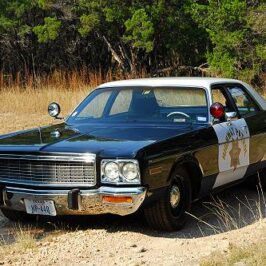
California Highway Patrol 1971 Dodge Polara #7091
There’s no question that the black and white patrol cars of the California Highway Patrol (CHP) are one of Americas most iconic cop cars. Imagine driving down the 101 enjoying the Pacific coast, looking at your speedometer and realizing that your speeding, and then looking in your rear-view mirror and seeing this beast behind you with a 440 CID V8 ready to chase you down. That patrolman it isn’t holding a steering wheel, it’s a leash. This dog is ready to chase a rabbit! Do you feel lucky rabbit? You’re probably better off rolling over like a puppy and begging for forgiveness.
This particular cruiser served the California Highway Patrol in the North Bay area of Santa Clara and comes complete with a CHP letter granting permission to use their logo while displaying the vehicle at shows.
The 1971 Dodge Polara used by the California Highway Patrol represents one of the final iterations of the high-horsepower, “Fuselage-era” Mopar interceptors before emissions mandates severely detuned American V8s.
CHP 1971 Dodge Polara Specs
Powertrain and Performance
U-Code High-Performance 440 V8: The heart of the CHP Polara was the U-Code 440 cubic-inch V8 topped with a four-barrel carburetor. Due to a drop in compression ratios to 9.7:1 to comply with tightening emissions regulations, gross output dipped slightly from the 375 hp of the legendary 1969 model to 370 horsepower.
A-727 TorqueFlite Transmission: Power was sent through a heavy-duty three-speed automatic transmission built to police specifications. The CHP package included an oversized fluid cooler (bumping capacity to 19 pints of automatic transmission fluid) and a high-speed governor to handle sustained high-RPM driving.
High-Speed Capabilities: While the drop in horsepower meant it couldn’t quite match the 149.6 mph top speed of the 1969 Polara, the 1971 CHP units still recorded top speeds of approximately 141 mph on open highways.
Heavy-Duty Components & Handling
Stiffened Suspension: Unlike the soft, vague suspension typical of civilian C-body Mopars, the CHP Polara utilized maximum-duty torsion bars, heavy-duty leaf springs, and a thick front anti-sway bar.
Braking System: The fleet cars featured massive, 11-inch front disc brakes mated to semi-metallic pads and 11×2.5-inch rear drums, regulated by a specific proportioning valve to resist fade during high-speed pursuits.
Exhaust: The CHP package mandated massive dual 2.5-inch exhaust pipes flowing into Hemi-style mufflers.
Interior and Special Equipment
Certified Speedometer: The vehicle’s dash layout was dominated by a certified 140 mph speedometer calibrated with a “Lodax” magnet for absolute accuracy.
Severe-Service Interior: The cabin completely skipped luxury carpet in favor of a black or gray heavy-duty rubber floor mat for effortless cleanup. The seats were wrapped in industrial-grade K1A9 gray vinyl and cloth, purposefully built flat to remain comfortable when an officer was wearing a heavy utility belt.
Electrical Upgrades: To support the constant draw of a Motorola two-way radio, a Federal Interceptor siren controller, and auxiliary lights, the cars came equipped with high-output 65-amp alternators.
California Highway Patrol Equipment

Lighting / Controls
California Highway Patrol cars from this era had a panel on the dash with the following indicator and switches:
The Pilot Light – This was a single, prominent red jewel light or incandescent indicator lamp mounted on the face of the plate. It served as a Master Safety Indicator. If any emergency circuit was left active (especially the rear deck lighting), this pilot light stayed illuminated to remind officers that it was still lit.
Outside / Inside Switch – Officers didn’t start carrying portable radios until 1981. This switch enabled the officer to switch the cars 2-way radio to an external speaker so they could hear radio traffic when outside of the car.
Siren / Horn Switch – When moved from the Horn to Siren position, it allowed the electro-mechanical siren to be operated by the horn button.
- NOTE: The California used BOTH electromechanical and electronic sirens during this time frame.
Red / Amber Switch – This controlled the Unity H1 amber and red lights mounted on the rear deck (parcel shelf). This was typically a 3-position toggle switch (Up / Center Off / Down):
- Red (Steady Burn): This activated the rear-facing stationary steady-burn red light. By California Vehicle Code, a forward-facing or rear-pointing steady red light legally signified an emergency vehicle demanding the right of way.
- Amber (Flashing / Directional): This activated the amber warning flasher. This was used when parked at the scene of a hazard or a disabled vehicle to alert approaching traffic to slow down or move over.
- NOTE: Both of these lights were not used at the same time.
Spotlight / Front Warning – There isn’t any switches for any forward-facing lights. The only warning light on the front of the car was a red spotlight on the driver’s side windshield post, and the switch was built into the directional handle. The passenger spotlight was a regular clear “white” light.


Siren & Radio
In 1966 the California Highway Patrol was using Federal Model C4B electro-mechanical sirens. These sirens could be activated by the horn ring when the dash mounted Siren / Horn switch was in the ‘Siren’ position. In 1967 the CHP started installing Federal PA-20A electronic sirens, but the ‘Yelp’ and ‘Hi-Lo’ tones were disabled so that only the ‘Wail’ could be used. Supposedly the CHP believed that a steady, rolling “Wail” was more authoritative on wide-open interstate corridors, and that erratic yelp tones confused civilian drivers.
The CHP continued using the electro-mechanical sirens until 1973 even though the cars were being equipped with electronic sirens. That means that this 1971 Dodge Polara would have had BOTH an electro-mechanical and electronic siren when it was put into service.
Above the siren is a Motorola “Motran” type X51LLT-3490A 2-way radio specially built by Motorola for the California Highway Patrol.
No Cage / Divider
Up into the 1990’s it wasn’t uncommon for Highway Patrol agencies across the country to have patrol cars without a cage / divider to separate the officer from back seat occupants and they all had their own policies on transporting prisoners.
For the CHP, their policy required that the call the local sheriff or police, when possible, to transport the prisoner to their jail. If transporting a prison themselves, the prison was handcuffed behind their back, placed in the back seat, and tightly seat belted in place. If they were operating as a two-man car, the second officer would sit in the back seat behind the driver, and the prisoner would be handcuffed behind their back and seat belted in the right rear seat.
That may seem crazy today, but I can tell you that as a trooper back in the 1990’s, I transported many prisoners handcuffed and seat belted in the front seat.


Hand Painted Car Numbers
For more information on the hand painted car numbers on this CHP Dodge Polara, check out:
Photo Gallery


About The Author

Code 3 Garage
I started my career as a police officer in 1989 with the Geneva on The Lake Police Department. I worked part time as a police officer and full time as a Security Sergeant doing armed mobile security patrols for a local security company. In 1990 I became a State Trooper with the Ohio State Highway Patrol. During my career as a State Trooper I was certified as a Technical Crash Investigator, OPOTA Police Instructor, OPOTA Police Driving Instructor, LASER Instructor, and received awards for ACE (Auto Larceny) and Post Trooper of The Year. Code 3 Garage is a mix of my inner automotive gearhead, and public safety background. I hope you enjoy it!